From Almaty to Practising Doctors: First Wave of Indian Medical Graduates Reflect on Studying in Ka
Author: Chris Trickett, saqtimes.kz
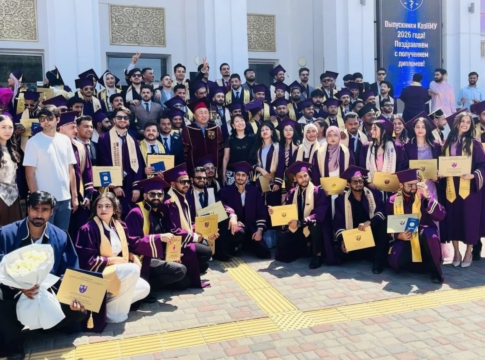
Graduation Day at Asfendiyarov National Medical University - all images from Dr Ankit Singh
Even with international students now a fixture in the southern Kazakh city of Almaty, local people may not have been keeping close enough track of time to notice that it is by now the best part of a decade since the first bridge was crossed by the original undergraduates from the Subcontinent.
Five years in Almaty would be a great experience for almost anybody, but for a lot of the students who originally took what at the time could reasonably have been described as a leap into the unknown, their time in Kazakhstan has been both rewarding and productive, as well as to the mutual benefit.
This summer saw the first large groups of Indian (and other) medical students graduate from top universities in Almaty, the most successful of them already in post as doctors in their home countries.
It is believed that the standard period of medical undergraduate study will be extended, but for the first group of those who chose to come to Kazakhstan and pursue their careers on the newly introduced English-language-medium medical courses, it is now time to say goodbye to their second homeland and begin their careers back where they originally came from.
Dr Ankit Singh is one such graduate whose five years at theAsfendiyarov National Medical University equipped him with the skills and knowledge needed to pass the screening examination in his home country so as to become a doctor in India. He lived in Almaty for five years and was a highly respected member of his student community, in part because of the experience of Almaty that he was able to share with new arrivals.
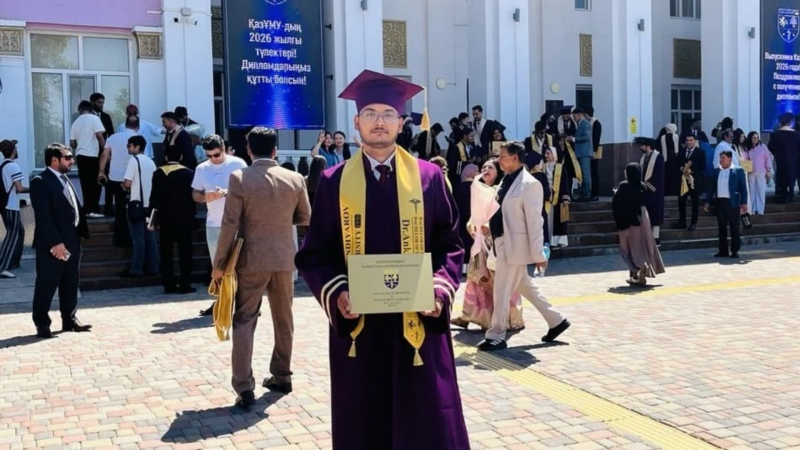
Dr Ankit Singh
He explained to us that, now back in India, he misses Almaty but is ready to take the first steps in his chosen career back near his family:
“Important though it was, Almaty was just the first step for me in a longer career.
“As for the city which I called home for years, it took a little time to adapt to life there, all the more challenging because I was one of the first students from my country to move over, and we didn’t have the experience of mentors to draw from.
“Some of us needed more time than others, and a few of my friends recall how they just wanted to go back home when they were new in Almaty. I guess homesickness can affect any young person.
“When we explored the city and the area and got to know it, we came to love it, and now we see Kazakhstan as a second homeland.”
Dr Singh has now qualified as a doctor and believes that his training in Almaty was of paramount importance.
“I needed to take an exam in India, and I did so. Thanks to my course, I was very well prepared for this test, so now I am a doctor, but I am not going to settle yet.
“I have plans to become a paediatric specialist, which will require me to work as an intern for a while.”
Some of his group have stayed on in Almaty and are still in the city, many of them keen to add another year of study, which will make a total of six. Recent discussion at the top has centred around theproposal to extend the standard medical degree course by a year, but the original five-year option was part of the reason that many international students opted to come to a country which until recently didn’t welcome many incoming alumni from outside the former USSR.
As that has changed, and seems set to continue to change, it would be quite reasonable to conclude that the primarily Indian community of students (by no means exclusively Indian) and thework they have done tobuild bridges both within their university and beyond it is part of the reason that more and more people aiming to get a good higher education have Kazakhstan on their shortlist.
Going from a once unknown educational destination to a very reasonable consideration for teenagers across the world has happened for many reasons, but what prospective undergraduates value most is the experience of those who have gone before them and know the reality of student life. This is precisely why the graduation of so many international students and their accounts of their time here are so valuable.
Nobody is under the illusion that time spent away from friends and family and the community you grew up in is always easy, with those challenges potentially doubling when you are right across the world. All in all, when approached for their opinion, the advice they give is likely to be balanced, that practical blend of what-to-do and what-not-to-do.
What recent months have proven, however, is that international students are increasingly sharing positive perspectives on this country.
The graduation of the first large group of such students and the news they share that they miss the country that got them started in their chosen careers is encouraging for everybody involved: officials, educators, local people, prospective students, and the graduates themselves.